

Understanding Silver Grades in Jewellery: Global History & Hallmarking Standards


Silver has captivated humanity for millennia—not just for its luminous beauty but also for its malleability and intrinsic value. In jewellery, the type of silver used significantly impacts both appearance and durability. Over centuries, different grades of silver have developed, each with distinct compositions and legal definitions. Let’s explore these grades and how different countries have historically standardised silver for jewellery.
1. The Main Grades of Silver in Jewellery
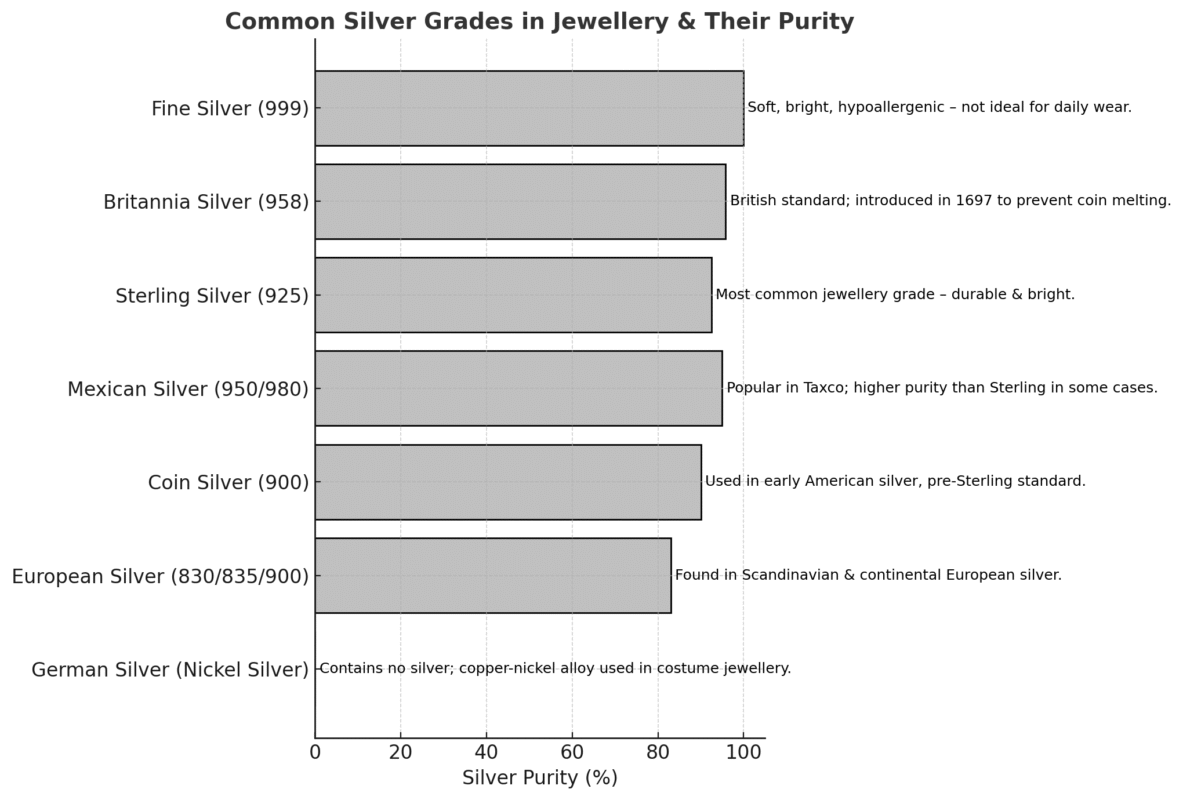
1. Sterling Silver (925)
- The most common silver alloy used in jewellery.
- Contains 92.5% pure silver, alloyed with 7.5% other metals (usually copper).
- Strong, bright, and hallmark-friendly, making it ideal for rings, necklaces, and bracelets.
2. Britannia Silver (958)
- Contains 95.8% pure silver.
- Softer and more malleable than sterling; used historically in fine British silverware.
- Adopted in the UK to deter melting of coins in the late 17th century.
3. Coin Silver (900)
- An older standard primarily used in the United States in the 18th & 19th centuries.
- Typically around 90% silver, originally made from melted coins.
- No longer common but still seen in antique American jewellery.
4. Mexican Silver (Marked 925 or “Plata”)
- Mexico is one of the world’s largest silver producers.
- Modern Mexican jewellery typically uses sterling silver, but earlier pieces (especially from Taxco) may be marked with finenesses like 980 or 950.
5. German Silver / Nickel Silver
- Misleading name: contains no silver.
- Alloy of copper, nickel, and zinc.
- Used in costume jewellery and decorative pieces—popular in 19th-century Europe.
6. Fine Silver (999)
- 99.9% pure silver, with minimal alloy.
- Bright and hypoallergenic, but too soft for everyday wear jewellery.
- Mostly used for artisan pieces, earrings, and collectable bullion jewellery.
2. Silver Hallmarking & Standards Around the World
United Kingdom
- The UK boasts the oldest formal hallmarking system, dating back to 1300, enforced by the Worshipful Company of Goldsmiths.
- By law, silver must be hallmarked if above a certain weight, ensuring metal purity.
- Standards include: 925 (Sterling), 958 (Britannia), and 999 (Fine Silver).
- The hallmark also includes an assay office mark (London, Birmingham, Edinburgh, or Sheffield), a date letter, and a sponsor’s/maker’s mark.
Europe
- Many continental European countries historically used higher silver standards, such as 830, 835, 900, or 950.
- Germany, Austria, and the Netherlands have hallmarking traditions dating back to the 16th century.
- French silver often uses the Minerva head to indicate official approval of 800 or 950 silver.
United States
- Lacked a mandatory hallmarking system until modern times.
- Early American silversmiths used coin silver; by the late 19th century, sterling silver became standard.
- Today, items marked “Sterling” or “925” conform to the international standard.
Scandinavia
- Sweden, Denmark, Norway, and Finland developed their own rigorous systems.
- Swedish silver is often marked 830, 835, or 925, with hallmarks including a triple crown or the letter “S”.
- Danish designers like Georg Jensen helped make sterling silver synonymous with Scandinavian modernism in the 20th century.
Mexico
- Since the 1930s, Mexico—particularly the town of Taxco—has produced high-grade silver jewellery.
- Older Mexican silver may be marked 980, 950, or simply “Plata”.
- Later marks often include an “M” number or eagle stamp to identify the maker and standard.
3. Why Silver Grades Matter in Jewellery
- Durability: Lower-purity silver (like sterling) is tougher and better suited to daily wear.
- Value: Higher-purity silver carries more intrinsic value but may be softer and more prone to dents.
- Allergy Considerations: Nickel-containing alloys (e.g., German silver) may cause skin reactions.
- Authenticity & Resale: Proper hallmarking ensures traceability and increases resale value.
Conclusion
From the gleaming Britannia silver of English teapots to the distinctive Taxco designs of Mexico, silver’s legacy is woven into the cultural fabric of jewellery-making across the globe. Understanding the different grades not only informs your purchases but also connects you to centuries of craftsmanship and regulation. Whether you’re a collector, a maker, or a wearer, knowing your silver makes all the difference.